
Managing domains
The “Domains” section of the dashboard shows all domains attached to the active project.
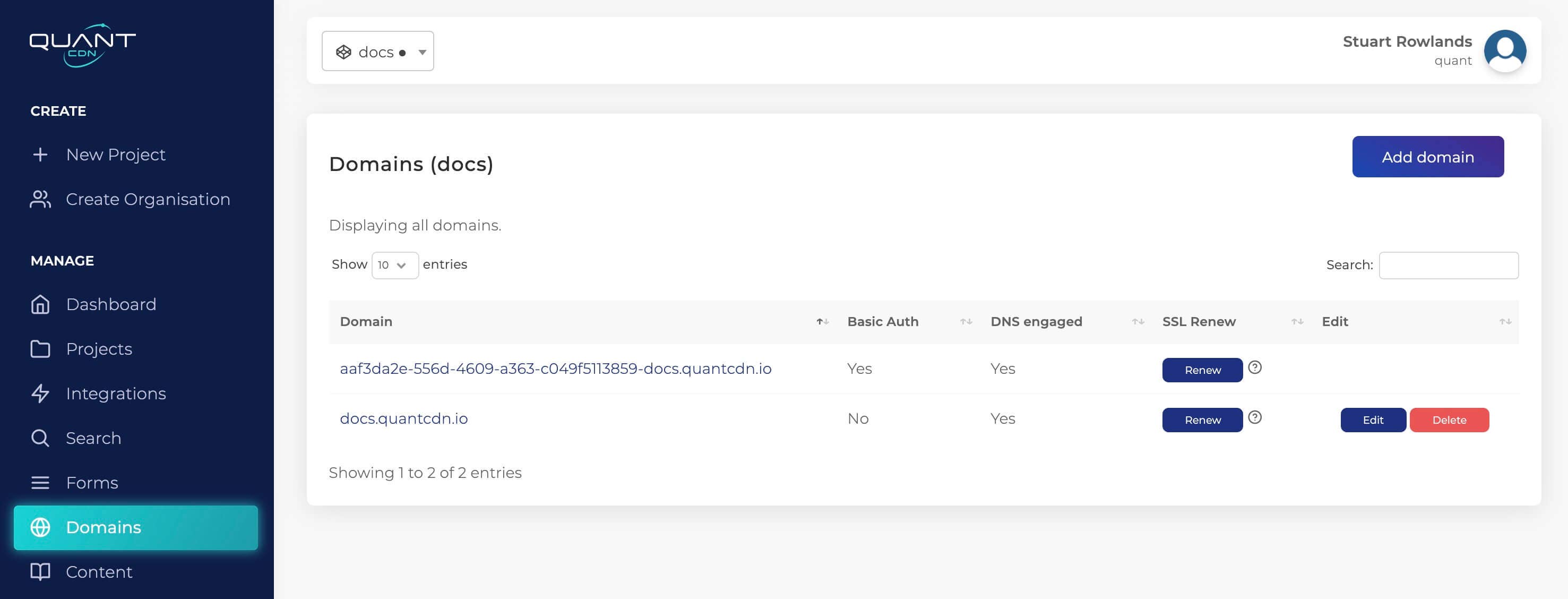
Add a domain
Section titled “Add a domain”Attach a domain with the “Add domain” button in the upper right. Enter the host name only, in the
format www.example.com, with no protocol or path. example.com and www.example.com are two
domains; add each host you serve.
You can also add domains with the API
(POST {dashboard}/api/v2/organizations/{organization}/projects/{project}/domains with
{"domain": "www.example.com"}) or with the Terraform quant_domain resource. Domains cannot be
renamed: delete the domain and add the new host name.
- A host name can belong to only one project. Adding a host that is already attached to any
project fails with “Domain already exists.” Use another host name for staging (for example
staging.example.com) or the preview domain. - Deleting a domain that has DNS pointed at Quant stops it working at once.
- Wildcard domains (
*.example.com) can be added on QuantGov only, and only for the certificate. Add each subdomain as its own domain so it routes.
A preview domain is automatically created for each project. This allows you to view and test your website on Quant prior to any DNS change. This preview domain:
- Emits
robots.txtcontent to prevent search engine indexing - Can have authentication applied to prevent public access
DNS records
Section titled “DNS records”Once a domain has been added, the DNS records to create appear at the top of the table. The API
returns them as dns_go_live_records (type, name, value, description). Create the records
shown for your project; do not copy targets from another project.
| Host | QuantCDN (dashboard.quantcdn.io) |
QuantGov (dash.quantgov.cloud) |
|---|---|---|
Subdomain (www) |
CNAME to the target shown | CNAME to the target shown |
Apex (example.com) |
A records with the addresses shown | ALIAS or ANAME record to the target host shown |
An apex domain cannot hold a CNAME. On QuantGov the target is a host name, so the apex needs a DNS
provider that supports ALIAS or ANAME records (Quant DNS does). If yours does not, serve the site on
www and redirect the apex.
If the domain’s zone is hosted in Quant DNS with CDN integration, Quant creates the records and the certificate for you. The domain shows “Auto-Managed” (QuantCDN) or “DNS & TLS automatically configured” (QuantGov).
SSL certificates
Section titled “SSL certificates”Quant provisions and renews free certificates for custom domains automatically. How a certificate starts differs by platform.
QuantCDN
Section titled “QuantCDN”The certificate is requested once Quant detects that your DNS points at it.
- After you add the domain, it shows “DNS Not Engaged” (and can show “Ready for TLS”).
- Create the DNS records. When Quant detects them, the domain shows “DNS Engaged” (API field
dns_engaged: 1) and the certificate is issued, normally within minutes. - If HTTPS fails right after the DNS change, click the “Renew” button next to the domain (API:
POST .../domains/{domain}/renew) to request the certificate now.
You may provide your own certificate and key when you add or edit the domain instead.
QuantGov
Section titled “QuantGov”On QuantGov the certificate is validated with DNS records before traffic moves, so the cutover has no certificate error.
- After you add the domain, the table shows “DNS Validation Pending” and “Required CNAME records”
(name and value). The API returns them as
dns_validation_records. - Create those CNAME records exactly as shown. Keep them in place; they are used for renewals.
- The status moves to “TLS Pending” and then “Active”.
- Then create the traffic record (CNAME or ALIAS above).
If the status shows “Dns Validation Failed” or “Validation Timed Out”, check the record with
dig CNAME <name>. A common mistake is a DNS provider that appends the zone name to the record name.